——长江的源头到底在哪里
Xu Xiake did not reach the modern source of the Yangtze. He did something earlier and essential: he corrected the direction of the question.
今天打开地图,长江源头通常标在青海唐古拉山地区,最远源流指向沱沱河。答案看起来清楚,像一道早已做完的地理题。
On a modern map, the source of the Yangtze is usually placed in the Tanggula Mountains of Qinghai, with the Tuotuo River identified as the farthest headstream. The answer looks settled.
但两千年前的人,并不是这样认识长江的。
It was not settled in Xu Xiake’s time.
经典流传的答案
《尚书·禹贡》有一句著名的话:“岷山导江。”在传统地理观念里,岷山发出的岷江就是长江的正源。后来的地理书、地方志和官方文献不断沿用这一说法。
An ancient classic, the Yu Gong chapter of the Book of Documents, declared: “Mount Min guides the River.” For centuries, this was read to mean that the Min River, rising in Sichuan, was the Yangtze’s true source. Historical geographies, local gazetteers, and official writings repeated the claim.
这并不难理解。经典在古代不仅是文学作品,也是知识的权威来源。一个观点被写进经书,又被历代学者引用,便很容易从“一个判断”变成“人人都知道的事实”。
That authority made sense in an imperial culture. A classic was not merely an old book. It was a foundation of knowledge. Once a statement had been written into a revered text and cited by generations of scholars, it could pass from interpretation into unquestioned fact.
徐霞客尊重经典,却不把经典当成终点。他的问题很简单:如果把河流看成一条连续的干流,究竟哪一支更长?哪一支的水量更大?哪一支的方向更能连接上游与下游?
Xu Xiake respected the classics, but he did not treat them as the end of inquiry. His questions were practical. If a river is understood as a continuous main stem, which branch is longer? Which carries the greater flow? Which direction actually connects the upper river to the lower one?
沿金沙江向上
西南远游时,徐霞客亲自考察金沙江及其支流。他看河道的宽窄、流向和汇合关系,询问当地人,也把不同记载放在一起比较。
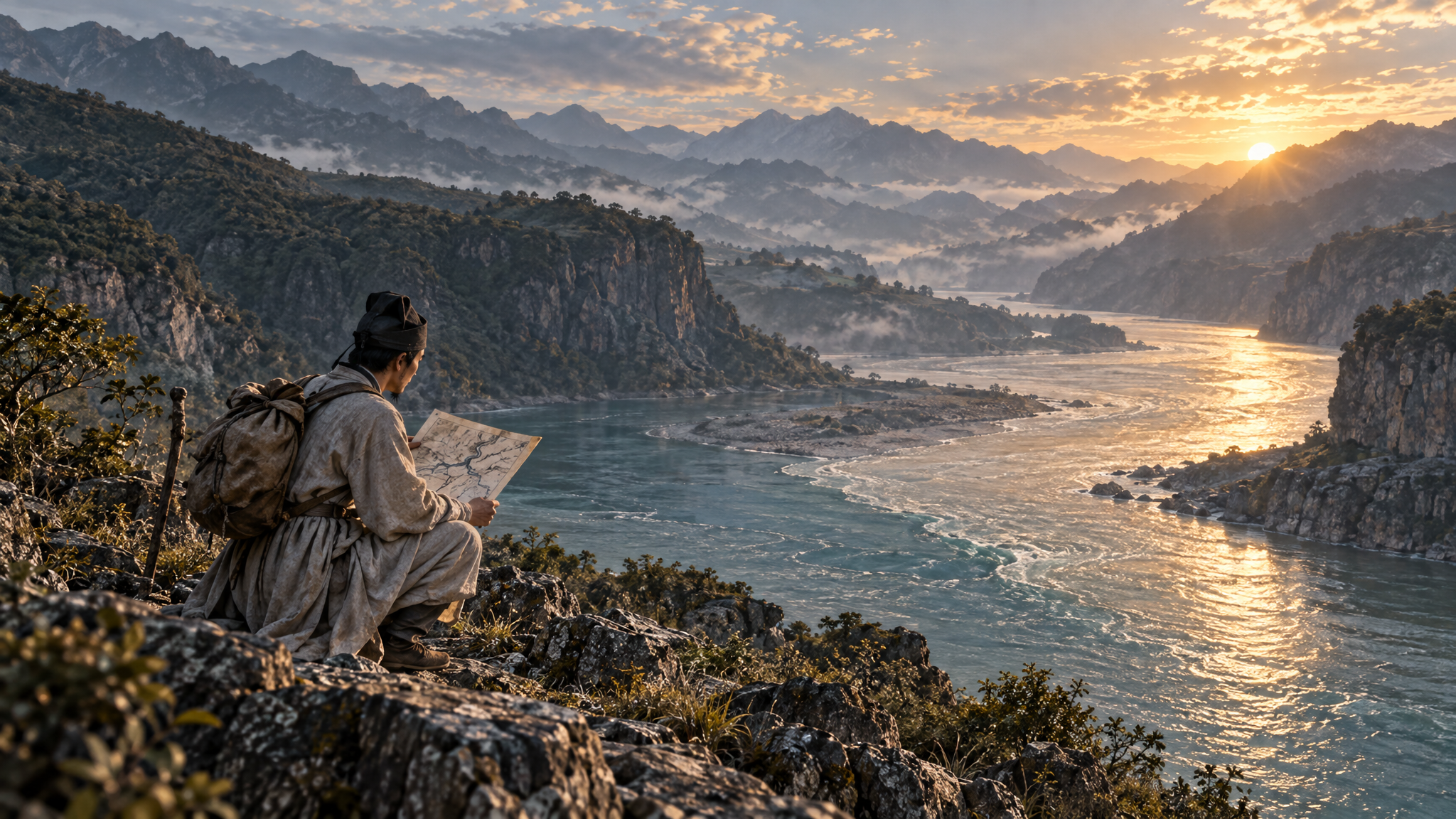
During his travels in southwest China, Xu examined the Jinsha River and its tributaries. He observed the width and direction of channels, watched where rivers joined, questioned local people, and compared accounts that did not agree.
在他的判断中,金沙江并不是长江旁边的一条普通支流,而是长江干流在上游的延续。与岷江相比,金沙江更长,所指向的源头方向也更远。因此,“岷山导江”不能准确说明长江主干的源流。
His conclusion was that the Jinsha was not an ordinary tributary beside the Yangtze. It was the upper continuation of the main river. Compared with the Min, the Jinsha extended farther and pointed toward a more distant headwater. The old phrase “Mount Min guides the River,” he argued in writings associated with Tracing the River to Its Source, did not correctly identify the main source system.
他在《溯江纪源》等文字中写下这一认识。重要的不是他提出了一个新名词,而是他改变了论证方式:地理问题不能只靠引用文献解决,还需要通过实地探测来证实。
The significance was methodological. A geographical question could not be settled by quotation alone. One had to stand beside the water and ask where it came from.
他没有抵达现代地图上的最远源头
这里需要说清楚一件事。徐霞客并没有准确找到今天意义上的长江最远源头,也没有抵达现代地图所标注的沱沱河源区。他确认的是金沙江在长江源流体系中的主干地位,纠正的是把岷江当作正源的传统判断。
There is an important limit to the claim. Xu Xiake did not locate the farthest source as modern hydrology defines it. He did not reach the Tuotuo headwaters marked on today’s maps. What he established was the Jinsha’s position as the main upstream course of the Yangtze, and he challenged the traditional identification of the Min as the primary source.
到了二十世纪,科学考察队带着测量、地形和水文工具继续向上游推进,最终把现代意义上的源头追溯到唐古拉山地区的沱沱河。后来的结论没有抹去徐霞客的工作,反而显示出他的判断为什么重要:他走到了当时条件允许的关键位置,把正确的方向交给了后来的人。
Twentieth-century scientific expeditions continued upstream with topographic surveys, hydrological measurements, and modern maps. They eventually traced the modern source to the Tuotuo River in the Tanggula region. This later work did not erase Xu’s contribution. It shows why his contribution mattered: he reached the crucial part of the system that his era allowed him to reach, and he handed later investigators the right direction.
科学不是一个人抵达终点,而是一场接力。前一个人把错误答案排除,后一个人把距离再向前推进。
Science is not one person arriving at a final point. It is a relay. One investigator removes a bad assumption; another carries the measurement farther.
经典为什么需要被验证
徐霞客的做法,对今天仍然有用。我们每天都生活在别人总结好的信息里:一个地方“大家都说”很危险,一条路线“向来”只有一个走法,一个观点“从来”没有人质疑。多数时候,这些说法可能有道理;但道理不等于证据。
Xu’s example also speaks to the way we handle information today. We live among inherited summaries: a place is “always” dangerous, a route has “only” one possible line, a claim has “never” been questioned. Such statements may be useful, but usefulness is not proof.
徐霞客不是为了反对经典而反对经典。他真正反对的是,没有到现场就把传闻当结论。他既读书,也走路;既记录所见,也承认尚未看清的部分。这种克制,比一句“我发现了真相”更接近科学。
Xu did not reject the classics for the pleasure of rebellion. He rejected the habit of treating an unvisited description as a final answer. He read, walked, compared, and admitted what he had not yet seen clearly. That restraint is closer to science than the dramatic claim to have discovered everything.
河流比王朝更长
长江从雪山和冰川附近出发,穿过高原、峡谷、平原,最后汇入大海。它不属于某一部书,也不属于某一个王朝。徐霞客用一段步行,把一条河的故事从经典的阴影里重新照亮。
The Yangtze is longer than any dynasty. It rises near snow and ice, crosses plateau and gorge, travels through plains, and enters the sea. It belongs to no single book and no single empire. With a stretch of walking, Xu Xiake brought its story out from under the shadow of inherited authority.
他并没有完成最后一公里,却完成了最重要的转折:当所有人都在重复旧答案时,有人愿意沿着水流逆行,亲自问一句“真的如此吗?”
He did not complete the last mile. He completed the decisive turn: when everyone else repeated the old answer, he walked upstream and asked, “Is it really so?”
下一篇,我们把目光从河流转回他的生命。1641 年他去世,三年后明王朝覆灭。一个时代正在崩塌,而他仍在追逐自己的山河梦想。
Next, we return to his lifetime. Xu died in 1641. Three years later, the Ming dynasty collapsed. An empire was coming apart, and he was still pursuing the mountains he had chosen.