——面向中文学习者的文化导读
A cultural guide for learners of Chinese.
武侠小说里,作者花了大量笔墨去描写武功:你会惊叹于降龙十八掌的威力、独孤九剑的潇洒。
In wuxia novels the author spends a great deal of ink describing martial arts: you marvel at the power of the Eighteen Dragon-Subduing Palms, at the elegance of the Nine Swords of Dugu.
但透过这些武功,金庸也在和我们聊他的一些想法。今天我就挑几个出来说说。
But through these arts, Jin Yong is also sharing some of his own thoughts with us. Today I want to pick out a few of them.
这一篇不排高下,只讲三个人的三段故事——鸠摩智、令狐冲、扫地僧。合起来,是三重境界。
This article skips the rankings and tells three stories about three people — Jiumozhi, Linghu Chong, and the Sweeping Monk. Together they make three levels.
一、第一重:鸠摩智的“捷径”
1. Level one: Jiumozhi’s shortcut
《天龙八部》里有个特别骄傲的和尚,叫鸠摩智。他是吐蕃国师,武功极高,还一心想把少林寺的绝技全都学到手。
In Demi-Gods and Semi-Devils, there is a very proud monk named Jiumozhi. He is the state preceptor of Tibet, an extremely powerful fighter, and he wants nothing more than to collect every technique in Shaolin Temple.
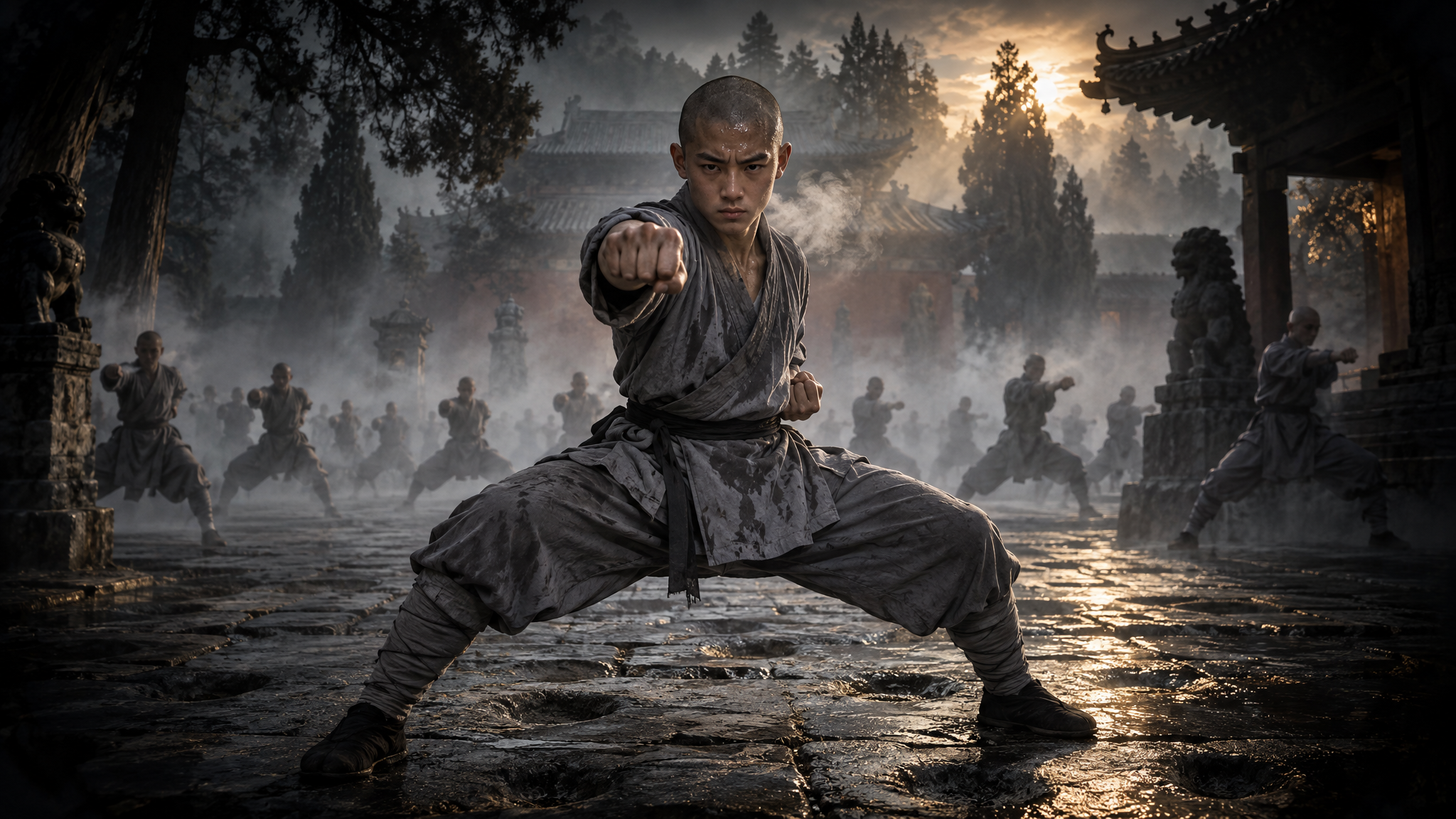
问题是,少林七十二绝技不是“学得快”就能拿走的。每一门都需要几十年苦功,还要配上相应的佛法修为。
The trouble is that Shaolin’s seventy-two arts cannot simply be taken by learning fast. Each one takes decades of hard practice, and each requires a matching depth of Buddhist cultivation.
鸠摩智想了个办法:用逍遥派的小无相功去催动少林的招式。看上去招招都是少林功夫,内核却是另一套东西——形似,神不是。
So Jiumozhi finds a workaround: he uses the Xiaoyao school’s Minor Formless Skill (小无相功, xiǎo wú xiàng gōng) to drive Shaolin’s moves. Every gesture looks like Shaolin kung fu, but the engine inside is something else entirely — same shape, different soul.
他自己很得意。直到藏经阁里那位扫地的老和尚看了他一眼,说了一句很冷的话:你身上已经有内伤了。
He is rather pleased with himself. Until an old monk sweeping the library floor glances at him and says something very cold: you are already injured inside.
扫地僧的解释朴素得近乎无聊:少林每一项绝技都是伤人要害、取人性命的狠招,所以每一项都需要相应的慈悲佛法去化解那股戾气。鸠摩智只学了杀人的部分,没有学化解的部分,还把别派的内功硬套上去——练得越多,伤自己越深。
The Sweeping Monk’s explanation is almost boringly simple. Every Shaolin art is a vicious move aimed at vital points; each therefore needs a matching measure of compassionate Buddhism to dissolve the violence it builds up. Jiumozhi learned only the killing half and skipped the dissolving half, then forced another school’s inner energy underneath it. The more he practiced, the deeper he wounded himself.
结局也很公平。鸠摩智后来在枯井中真气失控,一身功力被人尽数吸去;可失去武功之后,他反而真正成了一代高僧。装了几十年的东西,这一刻才成了真的。
The ending is fair. Jiumozhi falls into a dry well, his inner energy finally running wild; in the aftermath his power is drawn out of him entirely. And yet, having lost it, he becomes a genuinely great monk. What he had been faking for decades, he finally is.
这一层讲的道理:本事要一层一层长出来。跳过基础去追结果,总有一天会为此付出惨痛代价。
The lesson here: real skill grows layer by layer. Skip the foundation and chase the result, and sooner or later you will pay a painful price for it.
二、第二重:随心所欲不逾矩——独孤九剑
2. Level two: freedom within the rules — the Nine Swords of Dugu
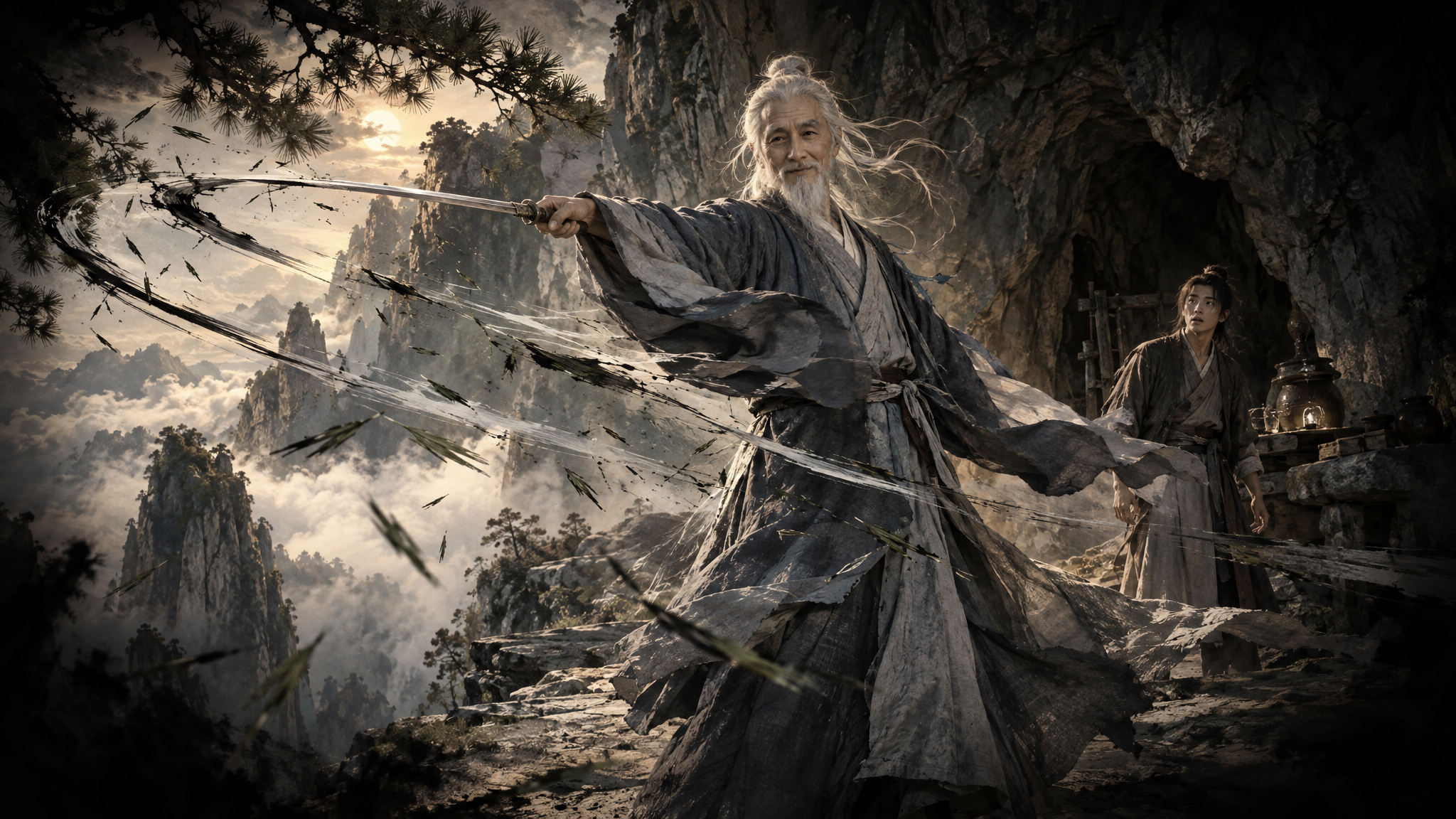
《笑傲江湖》里,风清扬教令狐冲独孤九剑,第一件事就是拆掉他对“标准答案”的依赖。
In The Smiling, Proud Wanderer, when Feng Qingyang teaches Linghu Chong the Nine Swords of Dugu, the first thing he dismantles is his student’s dependence on the correct answer.
他的道理很锋利:你的剑招使得再漂亮,只要看得出章法,敌人就能找到破绽;可如果你根本没有固定招式,敌人拿什么来破?所以叫“无招胜有招”。
His logic is sharp: however beautifully you perform a technique, if it shows a pattern, your enemy can find the seam. But if you have no fixed moves at all, what is there to break? Hence “no technique defeats technique” (无招胜有招, wú zhāo shèng yǒu zhāo).
但他并不是让令狐冲乱打。恰恰相反:先要熟到极处,才有资格忘。风清扬那句“招数是死的,发招之人却是活的”,说的就是这个意思。
He is not telling Linghu Chong to swing wildly. Quite the opposite: only someone who has mastered the forms completely has earned the right to forget them. That is what Feng Qingyang means when he says, “The moves are dead; the one who makes them is alive.”
这层境界,孔子其实早就说过。《论语》里他讲自己七十岁“从心所欲,不逾矩”——想怎么做就怎么做,却不会越出规矩。听起来矛盾,其实是最高级的熟练:规矩已经长进身体里,不再需要刻意遵守。
Confucius described this level long ago. In the Analects, he says that by seventy he could “follow whatever his heart desired without overstepping the rules” — 从心所欲,不逾矩 (cóng xīn suǒ yù, bù yú jǔ). It sounds contradictory, but it is mastery of the highest order: the rules have grown into the body, so no one has to consciously obey them anymore.
这一层讲的道理:自由不是没有规则,而是规则变成了本能。没有基本功的“自由”,只是混乱。
The lesson here: freedom is not the absence of rules; it is rules turned into instinct. Freedom without fundamentals is just chaos.
三、第三重:武功与慈悲——扫地僧
3. Level three: power and compassion — the Sweeping Monk
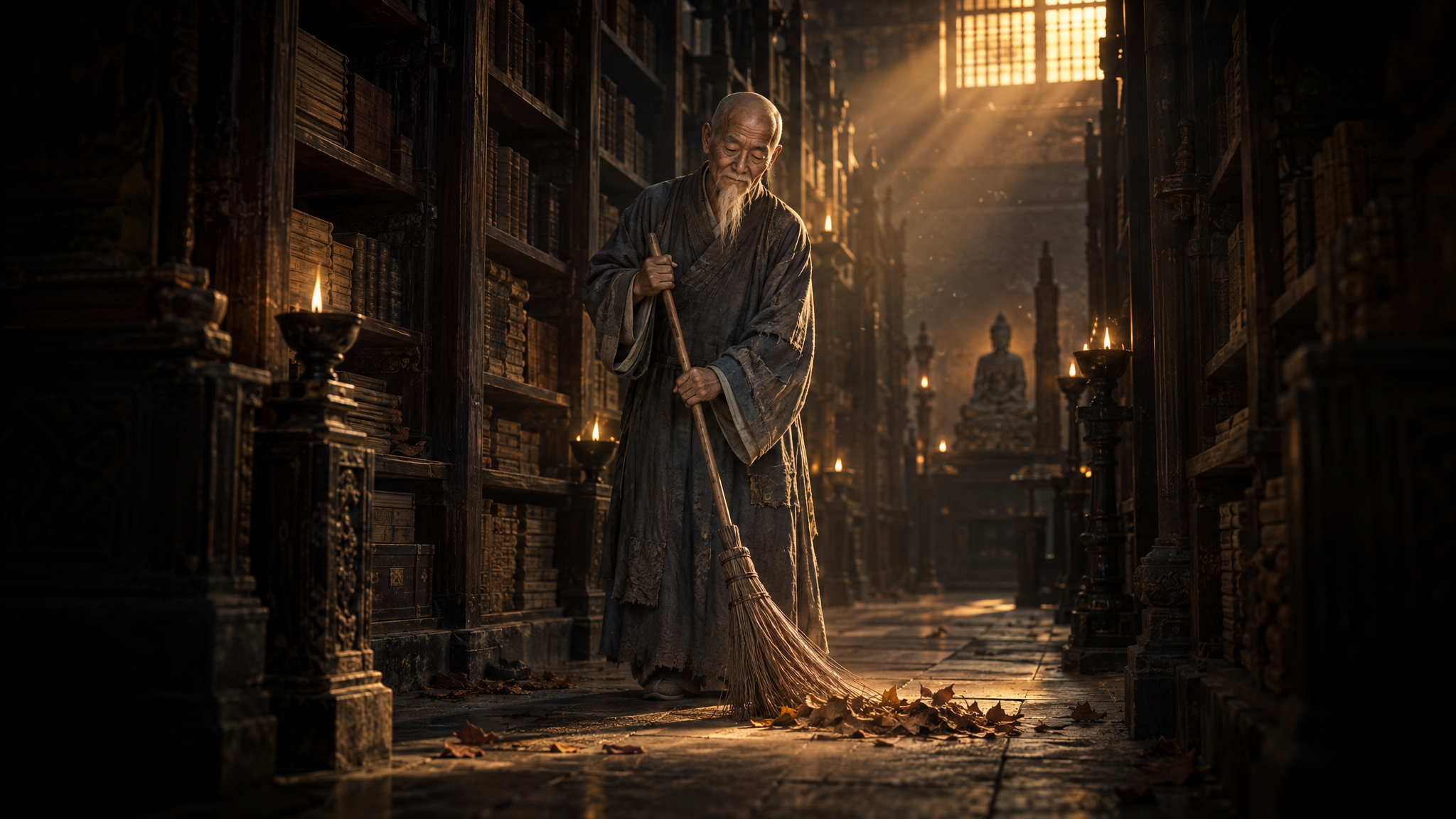
《天龙八部》里武功最高的人,是一个扫地的老和尚。他在少林寺藏经阁扫地,几十年没人多看他一眼。
The most powerful person in Demi-Gods and Semi-Devils is an old monk who sweeps floors. For decades he sweeps the library at Shaolin Temple, and nobody gives him a second look.
藏经阁那场戏里,萧远山和慕容博两位绝顶高手正为几十年的血仇对峙,扫地僧一出手就制住了他们,随后又把两人救了回来。他没有帮任何一方赢,也没有羞辱输的人。
In the library scene, two supreme masters, Xiao Yuanshan and Murong Bo, are facing off over a blood feud decades old. The Sweeping Monk subdues them in a moment, then brings both of them back. He does not help either side win, and he does not humiliate the loser.
他做的是另一件事:让两个被仇恨占满的人经历一次生死,然后给他们一个重新开始的机会。
He does something else: he lets two men consumed by hatred pass through death once, and then gives them a chance to start over.
然后他说出了全书最像哲学的一句话:
Then he says the most philosophical line in the whole novel:
佛法在求渡世,武功在求杀生,两者背道而驰,相互克制。
——《天龙八部》扫地僧 “Buddhism seeks to save the world; martial arts seek to kill. The two run in opposite directions and restrain each other.”
— the Sweeping Monk, Demi-Gods and Semi-Devils 意思很清楚:武功这门东西,天生是用来伤人的;慈悲是唯一能把它压住的东西。所以在他的门派里,武功越高,越需要慈悲来配。
The meaning is plain. Martial arts are born to harm people; compassion is the only thing that holds them down. So in his school, the higher your skill, the more compassion you need to match it.
没有慈悲的力量,练到最后不是天下第一,而是被自己的力量吞噬——鸠摩智就是活生生的例子。
Power without compassion does not end in being the strongest under heaven. It ends in being swallowed by your own strength — Jiumozhi is the living proof.
这一层讲的道理:前两重讲的是把刀练快,这一重讲的是这股力量应该用来做什么——武力天生带来暴力,但它也可以成为让人幸福的工具。
The lesson here: the first two levels are about making the blade fast; this one is about what the power is for. Force can bring violence — but it can also become a tool that makes people’s lives better.
结语:三重境界,一个问题
Conclusion: three levels, one question
把三个故事连起来,是一条很清楚的线:
Connected, the three stories make one clear line.
先老老实实地学(别学鸠摩智)→ 学到能把招式融会贯通(令狐冲)→ 用这股力量做让大家幸福的事(扫地僧)。
Learn it honestly, step by step (the opposite of Jiumozhi) → learn it until the moves become second nature (Linghu Chong) → then use that power to make life better for others (the Sweeping Monk).
金庸写武功,写的从来不是谁更厉害,而是——人在拥有力量的时候,选择成为什么样的人。
Jin Yong never writes about who is stronger. He writes about this: when a person holds power, what kind of person does he choose to become?