——比欧洲早两百多年的溶洞考察
With a torch, a notebook, and no map, Xu Xiake entered more than a hundred limestone caves in southwest China.
今天的溶洞,通常是旅游景点。入口有售票处,洞里有彩灯、栈道和语音导览,工作人员会告诉你钟乳石像什么。你只要跟着人群走,就能安全地游览完某个神奇的地下世界。
Today a cave is usually a managed attraction. There is a ticket booth at the entrance, a paved walkway underground, colored lights on the stalactites, and a guide who tells visitors what each rock is supposed to resemble. We follow the marked route and safely tour a magical underground world.
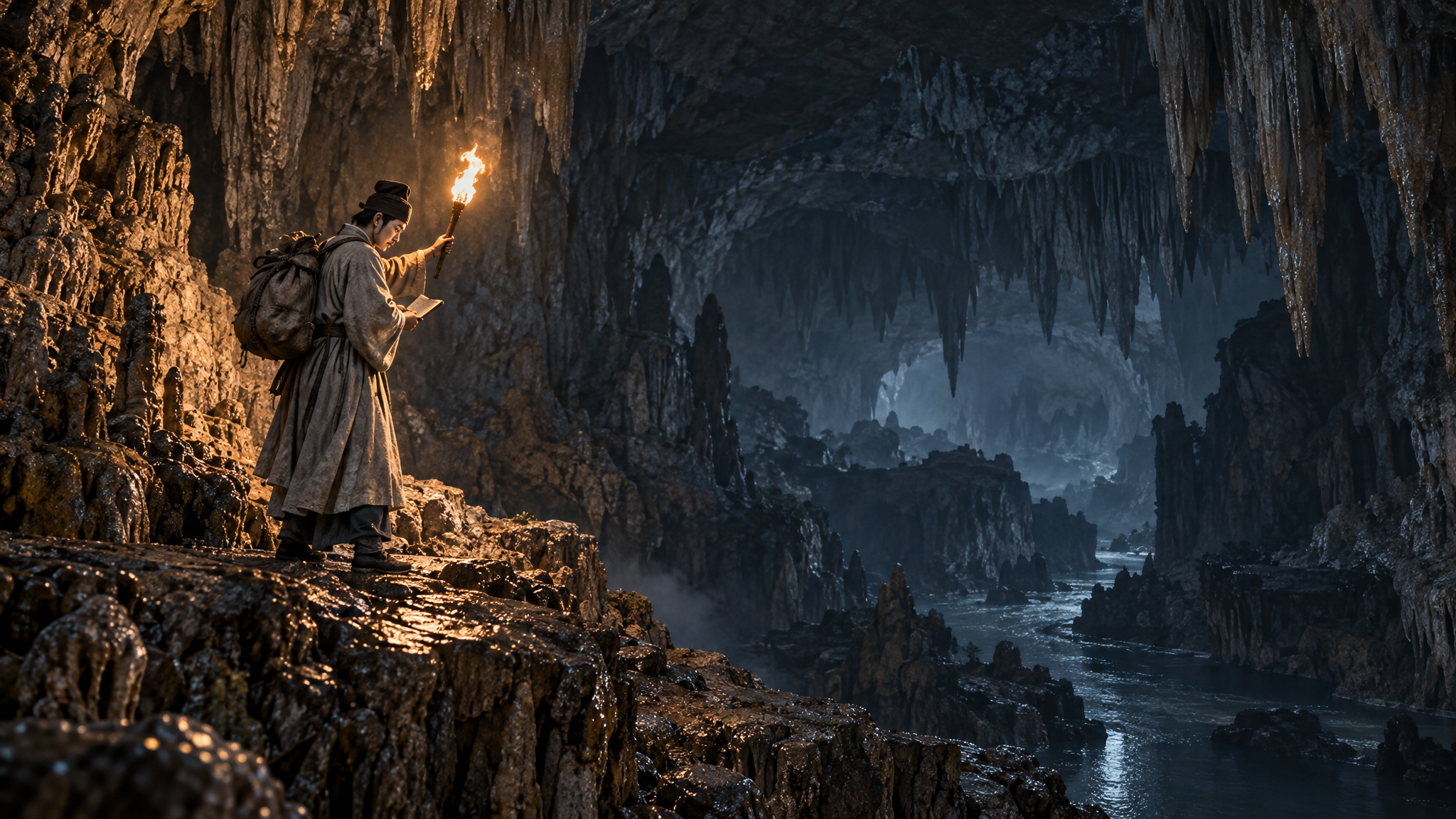
四百年前,广西的洞穴没有灯,没有地图,没有护栏,更没有人告诉你洞底会通向哪里。徐霞客走到洞口时,手里只有一支火把、一册纸和一颗不肯接受传闻的心。
黑暗里没有现成答案
明代的地理书常写山川形胜,却很少真正进入洞穴。洞在当时人的想象中,是神仙居所、龙蛇藏身之地,也是危险的黑洞。徐霞客却敢只身闯入这些龙潭虎穴去探索自然的真相。
In the seventeenth century, caves in Guangxi, Guizhou, and Yunnan had none of that. No electricity. No rails. No survey map. No rescue team waiting outside. When Xu Xiake reached a cave mouth, he carried a torch, paper, and the conviction that a rumor was not the same thing as a fact.
1637 年开始西南远游后,他在广西、贵州、云南一带考察了上百个石灰岩溶洞。这里的山不是普通的土石山,而是喀斯特地貌:雨水吸收空气和土壤中的酸性物质,沿着石灰岩裂隙下渗,一点点溶解岩石。千万年的水,把地表雕成峰林,把地下掏成洞穴和暗河。
Chinese geographical books of his time described famous mountains and rivers, but they rarely treated caves as objects of sustained study. To many people, a cave was a dragon’s lair, a place inhabited by immortals, or simply a dangerous hole in the ground. Xu Xiake was willing to enter these feared places alone and search for the truth of nature. To him, a cave was a natural system that could be entered, observed, compared, and described.
徐霞客未必使用现代地质学的术语,但他已经在追问同一组问题:洞穴有多高、多宽?入口朝向哪里?里面是否分层?水从哪边流来,又从哪边出去?两个洞口之间,会不会其实属于同一条地下通道?
After beginning his great southwest journey in 1637, he investigated more than a hundred limestone caves. The landscape he crossed is what modern geology calls karst. Rainwater absorbs weak acids from the air and soil, then moves through cracks in limestone. Over immense spans of time, that water dissolves the rock, carving towers and gorges above ground and caves, sinkholes, and underground rivers below.
他把火把举高,看烟气怎样飘;把脚伸进水里,判断暗河的深浅;在狭窄处伏身爬行,记录岩壁的纹理。他记石钟乳、石笋和石幔的形状,也记洞顶滴水的声音、地面泥沙的颜色。对他来说,美景不是观察的终点,而是提出问题的入口。
Xu Xiake did not have the modern word karst, but he was asking many of the same practical questions. How high is the chamber? How wide is the passage? Does the cave slope downward or open into another level? Which way does the water flow? Are two entrances actually connected underground?
在另一处洞穴记录里,他还写道:
He raised his torch and watched the smoke. He stepped into the water to judge its depth. He crawled through passages too narrow to stand in. He recorded stalactites, stalagmites, flowstone, mud, dripping water, and the changing texture of the walls. Beauty mattered, but beauty was not the end of his observation. It was the beginning of a question.
“余所见洞,皆从上入,惟此洞从下入。” 短短十六个字,先列出自己以往的经验,再指出眼前洞穴的例外。不同整理本的标点和个别字词略有差异,但这句话保留了一个旅行者在现场修正判断的瞬间。
七星岩:一份可以回到现场核对的记录
在桂林,徐霞客详细考察了七星岩等洞穴。他没有只写“奇幻”“幽深”,而是沿着洞道推进,辨认厅堂、岔口、低伏的岩缝和水流,努力把一个没有光的空间写成读者可以想象的地图。
In another cave entry he wrote: “Every cave I had seen entered from above; only this one entered from below.” The sentence first states his accumulated experience, then marks the exception in front of him. It is a field correction, not a tourist slogan.
流传的整理本中,还有一句极有空间感的描述:
At Seven-Star Cave in Guilin, one of the region’s celebrated underground landscapes, Xu Xiake wrote far more than “mysterious” or “beautiful.” He followed the passages and noted chambers, branches, low rock shelves, and streams. With words, he tried to turn a lightless, three-dimensional space into something like a map.
“一洞中有洞,洞洞相通;一水中有水,水水相通。” One line in versions of the diary circulated by later editors captures this sense of connection: “Inside one cave there are more caves; cave after cave is connected. Inside one watercourse there is more water; water after water is connected.” Punctuation and a few characters vary among editions, but the image is precise in spirit: a karst cave is a connected, changing three-dimensional system. 这不是景点宣传语,而是对喀斯特地下结构的直观概括:洞穴并非孤立房间,地下水也不是一条简单的暗沟。
Later investigators returned with instruments. Standard accounts hold that many of Xu’s descriptions around Seven-Star Cave — the direction of passages, their changing scale, and the distribution of notable formations — broadly correspond to what modern surveys find. “Broadly” matters. Xu did not produce a modern engineering survey. He did something more basic and, in its own way, remarkable: he left a field report that could be checked against the place itself.
后来的人带着测量仪器回到这些洞穴。通行研究认为,徐霞客对七星岩一带的方向、空间层次和景物分布的描述,与现代复测大体相合。这里的“大体相合”很重要:他不是用现代仪器完成了精确测绘,却在没有仪器的条件下留下了一份可被复核的现场报告。
People often say that Xu Xiake studied karst caves roughly two centuries before Europe developed systematic modern research in the area. The comparison needs a qualification. European speleology eventually became a coordinated science involving surveying, chemistry, geomorphology, and underground ecology. Xu did not create that institutional discipline.
这就是他的特别之处。他不满足于把洞穴写成诗意背景,也不把传说当成结论。他先看,再记,再比较;遇到解释不了的地方,就把疑问留在纸上。
比“欧洲早两百年”更值得注意的事
人们常说,徐霞客对喀斯特洞穴的系统观察,比欧洲近代意义上的相关研究早了约两百年。这句话应当谨慎理解。欧洲的洞穴学后来发展出测绘、化学、地貌学和地下生态等完整学科,徐霞客当然没有建立这样的现代体系。
What he did achieve was an unusually early form of sustained field observation. He did not enter one cave by accident. He compared caves across regions. Why do limestone towers gather in some valleys? How does underground water change direction? Why can the same landscape contain cliffs, sinkholes, and hidden rivers?
但在“一个人能否通过连续的实地观察认识地貌”这个意义上,他确实走得极早。他不是偶然钻进一个洞,而是把不同地区的洞穴放在一起比较:南方的峰林为什么成群出现?地下水为什么改变方向?石灰岩山地为什么同时拥有悬崖、天坑和暗河?
Science needs instruments, institutions, and generations of cumulative work. Curiosity can begin with a single torch. In the darkness, Xu performed the first movement of science: he turned the unknown into facts that another person could examine.
学科需要机构、仪器和几代人的积累;好奇心却可能从一支火把开始。徐霞客在黑暗里做的,正是科学最初的动作:把未知变成可描述的事实。
火把照见的,不只是洞
钻出洞口时,太阳会让人眩晕。徐霞客却已经把一小块黑暗带回纸上。那上面有石头的形状,水流的方向,也有一个人的判断如何形成。
When he stepped back into daylight, he carried a fragment of the underground world on paper: the shape of stone, the direction of water, and the chain of reasoning that connected one observation to the next.
我们今天进入景区,看见的是被灯光安排好的洞穴;读徐霞客,看见的是一个人怎样在没有答案的地方工作。他用身体深入,用文字保存,用一次次比较抵抗“大家都这么说”。
The caves also show why Xu Xiake was more than an adventurous tourist. He used his body to reach difficult places, his notebook to preserve what he saw, and comparison to resist the easy comfort of “everyone says so.”
下一篇,我们沿着他的脚步走到江边:两千年来被奉为经典的长江源流说,为什么会被一个布衣旅行者重新提出疑问?
Next, we follow him to a river. For two thousand years, a classic text had supplied the accepted source of the Yangtze. What happens when a cloth-clad traveler decides to test that answer on foot?