
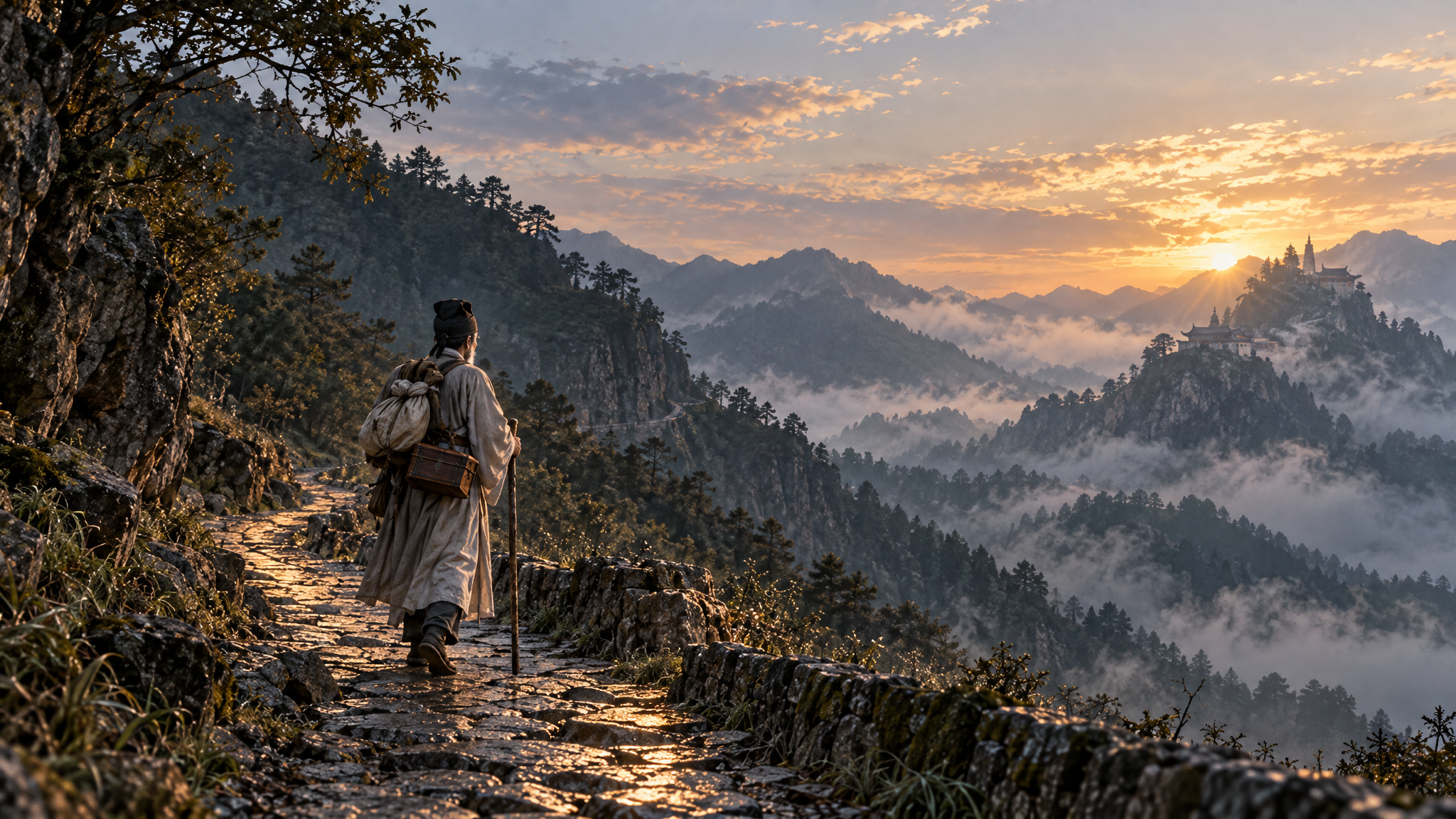
——他把朋友的骨灰背在身上,又走了一年
His companion died a thousand miles from home with one last wish. Xu Xiake carried him the rest of the way.
先讲一个僧人的故事。
First, the story of a monk.
静闻,一个游方的僧人。此生的执念只有一件:用自己的血,抄一部《法华经》。
His name was Jingwen, a wandering monk with a single obsession: to copy the Lotus Sutra in his own blood.
他不是抄一天、抄一年。他刺破手指,蘸着血,一个字一个字地写,一写就是将近二十年。经卷抄成那天,他许下一个愿:要把这部血经,供到云南鸡足山——佛经里说,那是迦叶尊者的道场,一个他从未去过、却在梦里朝拜过无数次的地方。
Not in a day, not in a year. He pricked his finger, dipped it in his own blood, and wrote, character by character, for nearly twenty years. When the scroll was finished, he made a vow: to present this blood-written sutra at Mount Jizu, in far-off Yunnan — a holy mountain he had never seen, though he had made pilgrimage to it in his dreams a thousand times.
这部经是他用半生心血换来的,是他的信仰所在。
This sutra was paid for with half a lifetime of his own blood. It was his faith itself.
1636 年,年近五十的徐霞客决定做一次毕生最远的旅行:从江阴出发,一路走到云南。路上,他遇到了静闻。
In 1636, Xu Xiake — then nearly fifty — resolved to make the longest journey of his life: from his hometown of Jiangyin all the way to Yunnan. On the road he met Jingwen.
两个各怀执念的人,从此结伴而行。一个要去亲眼看看山河的真相,一个要去完成毕生的心愿。
Two men, each carrying an obsession, became traveling companions. One wanted to see the truth of rivers and mountains with his own eyes. The other wanted to fulfill the vow of a lifetime.
湘江上的那一夜
The night on the Xiang River
1637 年春,两人行至湖南,夜泊湘江。
In the spring of 1637, the two were in Hunan, moored for the night on the Xiang River.
那一夜,一伙强盗扑上船来。刀光、水声、喊叫,乱成一团。徐霞客侥幸脱身,行囊被洗劫一空——钱、衣物、干粮,什么都没了。
That night, bandits swarmed the boat. Blades, water, shouting — chaos. Xu Xiake escaped with his life, but lost everything else: money, clothes, food. All gone.
混乱中,静闻护着那部血经,被人砍伤。
In the confusion, Jingwen shielded the blood-written sutra. He was cut down.
伤,一开始看着不重。可伤口在南方潮湿的天气里一点点溃烂,再也无法愈合。两人强撑着走到南宁,静闻终于走不动了。
The wound did not look serious at first. But in the humid south it festered and would not heal. The two struggled on to Nanning, where Jingwen could go no further.
临终的心愿
A dying man's wish
在南宁的寺庙里,静闻躺在病榻上,知道自己的路到头了。
In a temple in Nanning, Jingwen lay on his sickbed and knew his road had ended.
他对徐霞客说:我这一生,就为这部经活着。我走不到鸡足山了。你替我去——把经供上鸡足山,把我的骨殖也带去,葬在那里。
He said to Xu Xiake: All my life I have lived for this sutra. I cannot reach Mount Jizu. Go for me — offer the sutra there, and take my bones with you. Bury me there.
徐霞客含泪应下。
Xu Xiake, in tears, promised.
静闻死后,他把朋友的遗骨包好,背在背上;又把那部血经裹好,贴身藏好。然后,他一个人,继续向西。
When Jingwen died, Xu wrapped his friend's remains and bound them to his back. He wrapped the blood-written sutra and hid it next to his skin. Then, alone, he kept walking west.
一年的路
A year on the road
从南宁到鸡足山,要走多远?
How far is it from Nanning to Mount Jizu?
今天的人开车,也要一天一夜。四百年前,一个背负遗骨的人,要翻过广西的群山,穿过贵州的高原,再走进云南的深谷——全是当时地图上找不到的路。
Even driving today takes a day and a night. Four hundred years ago, a man carrying a dead friend's bones had to cross the mountains of Guangxi, climb the plateau of Guizhou, and descend into the deep valleys of Yunnan — roads that appeared on no map.
他背着静闻,走了一年多,走了数千里。
He carried Jingwen for more than a year, across a thousand miles of mountain road.
路上不是没有过犹豫。病、盗、断粮,他一样都没少遇。可那包遗骨始终在他背上。夜里投宿,他把经卷放在枕边,像守着一个诺言;白天赶路,他把遗骨背在身上,仿佛朋友还在身边同行。
There were moments of doubt, surely. Sickness, bandits, hunger — he met them all, as before. But the bundle of bones never left his back. At night, in whatever lodging he found, he laid the sutra beside his pillow, as if guarding a promise. By day he carried the bones, as if his friend were still walking beside him.
1638 年岁末,他终于登上鸡足山。
In the last days of 1638, he finally climbed Mount Jizu.
鸡足山上的了结
At the mountain's foot
在鸡足山,徐霞客把静闻的骨殖安葬在山脚下,把那部血写的《法华经》供进了寺院。
On Mount Jizu, Xu Xiake buried Jingwen's remains at the foot of the mountain, and offered the blood-written Lotus Sutra to the temple.
二十年的血,一部经,一个心愿——在徐霞客的背上,终于走完了最后一段路。
Twenty years of blood, one scroll, one vow — carried on Xu Xiake's back, the last stretch was finally done.
他还写了一组哭祭静闻的诗,把这份情义留在纸上。而真正传了四百年的,是这件事本身:一个素无血缘的同路人,替朋友走完了朋友没能走完的路。
He also wrote a set of mourning poems, leaving that loyalty on paper. But what has truly been told for four hundred years is the deed itself: a man with no blood tie to the dead walked for him the road the dead could not walk.
诺言的分量
What is a promise worth?
我们常问:一句承诺,值多少钱?
We ask: what is a promise worth?
徐霞客用一年多的时间、数千里的路程回答了这个问题:值一个人的命,值一部血写的经,值一座山。
Xu Xiake answered with more than a year of his life and a thousand miles of road: it is worth a man's life. It is worth a sutra written in blood. It is worth a mountain.
他不是静闻的亲人,不是静闻的债主。他们只是同路的人——一个是奔着山河去的旅行者,一个是奔着心愿去的僧人。可在静闻走不动的时候,他替他走了;在静闻到不了的地方,他把他送到了。
He was not Jingwen's kin. He was not Jingwen's creditor. They were simply two men on the same road — a traveler chasing the truth of mountains, and a monk chasing a vow. But when Jingwen could walk no further, Xu Xiake walked for him. Where Jingwen could not go, Xu carried him there.
古人讲"一诺千金"。徐霞客这一诺,重过千金——它压在他背上,走了一年多,翻过了数千里山路。
The old saying goes: a promise weighs a thousand in gold. Xu Xiake's promise weighed more than gold — it sat on his back for more than a year, across a thousand miles of mountain road.
这世上有一种情义,不需要血缘,不需要利益。就是:你托付给我的事,我替你做完。
There is a kind of loyalty that needs no blood tie and no profit: what you entrusted to me, I will finish for you.
下一篇,我们走进广西的溶洞。那些黑黢黢的洞,徐霞客举着火把钻了一百多个——比欧洲人正式研究洞穴,早了两百年。
Next, we go underground — into the caves of Guangxi, a hundred and more of them, explored with nothing but a torch, two centuries before Europeans began to study caves in earnest.