

——面向中文学习者的文化导读
A cultural guide for learners of Chinese.
先记一个词:侠(xiá)。
One word to remember first: 侠 (xiá).
如果你学中文,迟早会遇到它:武侠、侠客、侠义、大侠……在今天的中文里,它几乎总让人想到勇气、正义和英雄。
Sooner or later, every learner of Chinese encounters it: 武侠 (wǔxiá, martial-arts fiction), 侠客 (xiákè, a wandering hero), 侠义 (xiáyì, chivalrous righteousness), and 大侠 (dàxiá, a great xia). In modern Chinese, the word is closely associated with courage, justice, and heroism.
但两千多年前,中国思想史上对侠最有影响力的判断之一,却是一句严厉的批评。
Yet more than two thousand years ago, one of the most influential early judgments on the xia in Chinese intellectual history was a severe criticism.
这一篇,我们来看侠如何从一个“以武犯禁”的危险人物,逐渐成为中国人心中的道德英雄。
This is the story of how a dangerous “lawbreaker” became a moral hero.
一、这个字,并不能直接告诉我们答案
1. The character does not tell us the whole story
“侠”的繁体字是“俠”:左边是“亻”,右边是“夾”。按照《说文解字》的分析,它是一个形声字——“人”表示这个字与人有关,“夾”主要提示读音。
The traditional form of 侠 is 俠. It contains the human radical 亻 and the phonetic element 夾. According to the Shuowen Jiezi, it is a phono-semantic character: 人 means the word has to do with a person, while 夾 mainly indicates its sound.
所以,我们不能只把字拆开,就说“侠从造字之初便有扶助别人之意”。侠为什么后来与助人、守信和正义联系在一起,答案不在字形中,而在真实的历史评价中。
So the character itself does not prove that a xia was “someone who stood beside others to help.” If we want to know why the word later became bound up with helping people, keeping promises, and standing for justice, the answer is not in its shape. It is in how people judged the xia in real history.
二、在韩非眼中,侠是秩序的威胁
2. To Han Feizi, the xia threatened order
战国末期,思想家韩非主张,一个国家必须有统一的法令和权威。在《五蠹》(wǔ dù,Five Vermin)中,他把五类人视为危害国家的“蛀虫”,其中便包括儒者和侠。
In the late Warring States period, the thinker Han Feizi argued that a state needed unified laws and authority. In “Five Vermin” (五蠹, wǔ dù), he listed five kinds of people he believed harmed the state. Among them were the scholars and the xia — the “sword-bearers.”
他留下了一句极有名的话:
He left behind one of the most famous lines about them:
儒以文乱法,侠以武犯禁。
——《韩非子·五蠹》 “The literati disrupt the law through words; the xia violate prohibitions through force.”
— Han Feizi, “Five Vermin” 侠为什么“犯禁”?因为他们不等待官府裁断。
Why did the xia “violate prohibitions”? Because they did not wait for the authorities to judge a dispute.
他们替人复仇、排难解纷、招纳追随者,也可能用自己的武力决定谁对谁错。这等于在国家法令之外,建立了一套私人的是非和权力。
They avenged wrongs, settled conflicts, gathered followers, and sometimes used private force to decide who was right. In effect, they created a second set of judgments and a second source of power outside the state’s law.
我们今天也许会觉得“路见不平,拔刀相助”很勇敢,但站在统治者的位置上,问题完全不同:如果每一个有武力的人都能自行执法,谁来约束他们?如果他们判断错了,又由谁承担后果?
To ordinary people, such intervention might look courageous. To a ruler, it raised an entirely different question: if every armed person could enforce his own idea of justice, who would restrain them? And if their judgment was wrong, who would bear the consequences?
韩非批评的并不是抽象的善良,而是不受国家控制的私人力量。
Han Feizi’s target was not kindness. It was private power beyond state control.
文化注
Culture note
三、司马迁没有替侠洗白,却为侠辩护
3. Sima Qian did not excuse the xia, but he defended them
一百多年后,司马迁在《史记》中专门写下《游侠列传》。他没有否认游侠可能违法,开篇便承认他们的行为“虽不轨于正义”。但紧接着,他把视线从法律转向了人的品格。
More than a century later, Sima Qian devoted a chapter of the Records of the Grand Historian to the wandering xia. He did not deny that they could break the law: near the beginning he acknowledges that their conduct “did not always conform to orthodox standards of right.” Then he moves the question from legality to character.
其言必信,其行必果,已诺必诚,不爱其躯,赴士之厄困……而不矜其能,羞伐其德。
——《史记·游侠列传》 “Their words were trustworthy and their actions resolute. Once they made a promise, they kept it. They did not spare themselves when rushing to the aid of people in distress… Yet they did not boast of their abilities or parade their good deeds.”
— Records of the Grand Historian, “Biographies of the Wandering Xia” 这一段最重要的地方,不是把侠写成没有缺点的好人,而是承认了一种复杂性:一个人可能违反法令,却仍然守信;可能扰乱秩序,却愿意在别人危难时付出生命。
The point was not to present the xia as flawless. It was to recognize a difficult truth: someone could violate the law yet keep his word; could disturb order yet risk his life for another person in trouble.
韩非站在国家的位置上问:谁允许你使用武力?
Han Feizi stood on the side of the state and asked: who gave you the right to use force?
司马迁则站到人的面前问:当一个人身陷困境时,谁真的愿意来救他?
Sima Qian stood in front of a person in trouble and asked: when someone’s life falls apart, who will actually come to help?
两个问题都合理。侠文化延续两千年的力量,正来自这两个问题之间无法彻底消除的张力。
Both questions are reasonable. The power of xia culture to survive two thousand years comes precisely from the tension between them — a tension that can never be fully resolved.
为什么司马迁如此理解侠?
Why did Sima Qian see them this way?
我们或许可以从司马迁自己的经历中理解这种同情。
His own life may explain part of that sympathy.
他曾为战败投降的将军李陵辩护,触怒汉武帝,最终遭受宫刑。
He defended Li Ling, a general who surrendered after a defeat. The defense angered Emperor Wu, and Sima Qian was sentenced to castration.
他后来在《报任安书》中回忆,当时自己家贫,无钱赎罪,“交游莫救,左右亲近不为一言”——朋友没有救他,身边的人也没有替他说一句话。
In his famous “Letter to Ren An,” he recalled that he was too poor to buy his way out of punishment: friends did not come to his rescue, and no one close to the throne said a word on his behalf.
我们不能证明这段遭遇直接促成了《游侠列传》。但一个亲历“无人来救”的人,或许比别人更能感受到“赴士之厄困”几个字的重量。
We cannot prove that this experience directly produced the “Biographies of the Wandering Xia.” But a man who had lived through being left to his fate may have felt the weight of “rushing to the aid of people in distress” more keenly than most.
四、李白把侠写成了一个梦
4. Li Bai turned the xia into a dream
到了唐代,侠已经不只是历史人物,也成为诗人想象中的自由英雄。
By the Tang dynasty, the xia was no longer only a historical figure. He had become a free hero in the imagination of poets.
李白在《侠客行》中写道:
Li Bai wrote in “Song of the Knight-Errant”:
十步杀一人,千里不留行。
事了拂衣去,深藏身与名。 “Within ten paces, one man falls; across a thousand miles, nothing stops his way.
The deed complete, he brushes off his robe and leaves, keeping both himself and his name hidden.” 这里当然有暴力,也有夸张。但真正影响后世侠客形象的,是最后两句:做成大事,不领取奖赏,不夸耀功劳,甚至不留下姓名。
There is violence here, and deliberate exaggeration. But what shaped later images of the xia most strongly are the last two lines: the deed done, no reward claimed, no merit boasted, not even a name left behind.
司马迁赞美游侠“不矜其能,羞伐其德”;李白则把这种不自夸的品格写成了最潇洒的画面——事了,拂衣,转身而去。
Sima Qian praised the xia for not boasting of their abilities or parading their good deeds. Li Bai turned that virtue into an unforgettable picture: the deed done, the robe brushed off, the man already gone.
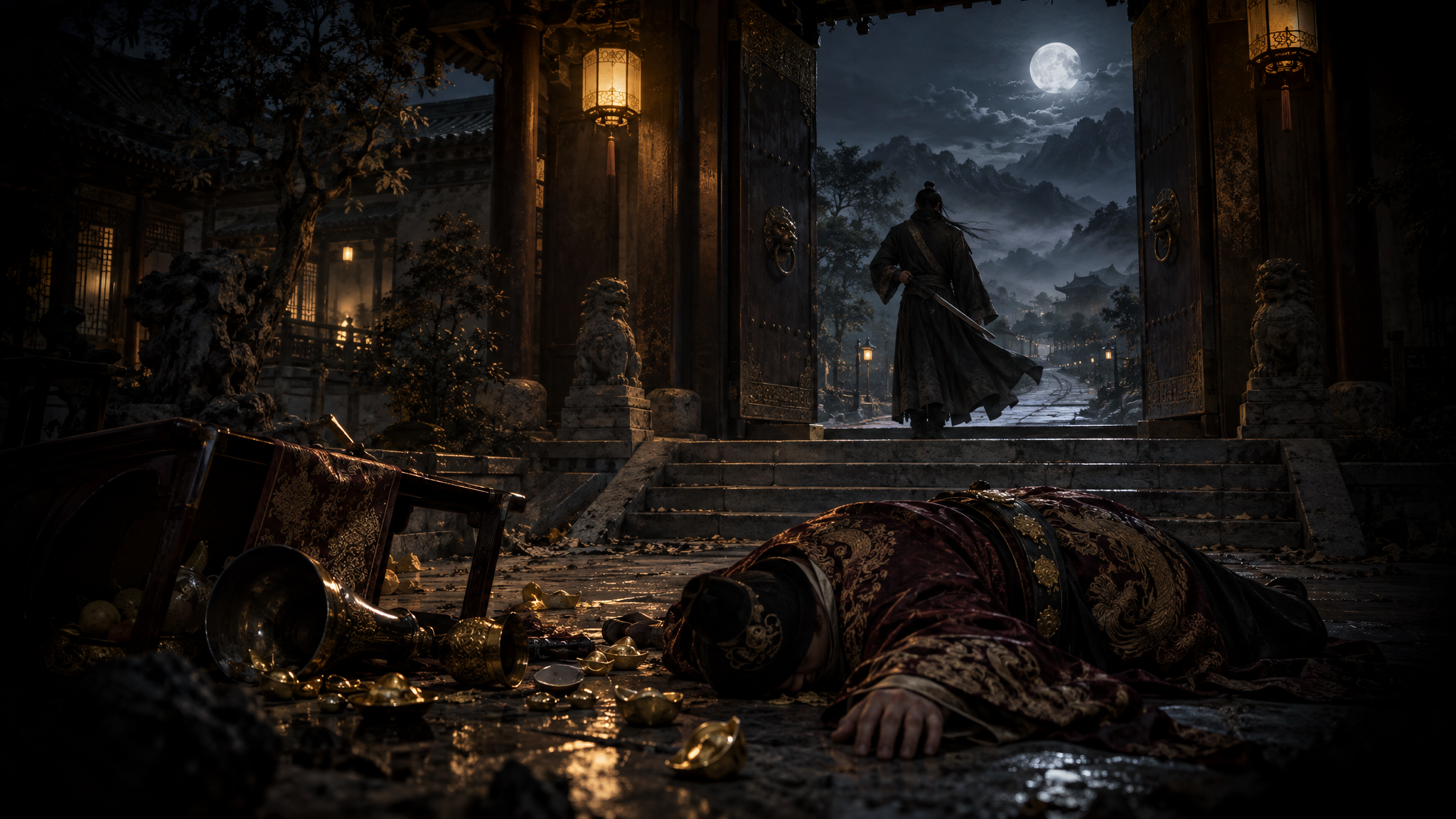
到了这里,侠已经完成了一次重要变化:他不再只是官方秩序眼中的危险人物,也成为民间想象中有能力却不贪恋权力、有功劳却不索取名声的人。
By then the xia had passed through an important change. He was no longer only a dangerous figure in the eyes of official order; he had also become the person the common imagination pictured as powerful without craving authority, and credited with great deeds without demanding fame.
五、侠的核心不是武功,而是“义”
5. The heart of the xia is not martial skill, but 义
侠一定要会武功吗?不一定。
Does a xia have to be a martial-arts master? Not necessarily.
真正决定一个人是否有“侠气”的,是他怎样使用自己的能力。这就涉及另一个重要的中文词:义(yì)。
What actually decides whether a person has “侠气” — a xia’s spirit — is how he uses whatever ability he has. That brings us to another important Chinese word: 义 (yì).
“义”很难用一个英文单词完全翻译。它包含 rightness、justice、moral duty,也包含“明知有代价,仍然去做该做之事”的意思。
No single English word captures 义 completely. It can mean rightness, justice, or moral duty — and it also carries the idea of doing what should be done even when you know it will cost you.
法律告诉人们什么不可以做,命令告诉人们必须做什么;“义”却要求一个人自己判断:眼前这件事,究竟应不应该做?
Law tells people what they must not do; orders tell them what they must do. 义 asks a person to judge for himself: in this situation in front of me, is this something that should be done?
《史记》里的朱家就是一个例子。汉高祖悬赏捉拿季布,并下令谁敢藏匿他,罪及三族。朱家明知风险,仍收留了乔装成奴仆的季布。
Zhu Jia, a figure in the Records of the Grand Historian, is an example. Emperor Gaozu put a bounty on Ji Bu’s head and decreed that anyone who hid him would be punished down to the third generation. Knowing the risk, Zhu Jia still took in Ji Bu, who had disguised himself as a bonded servant.
朱家没有拔剑动武。他赶到洛阳,请滕公(汝阴侯夏侯婴)向皇帝进言:季布过去效忠项羽,不过是各为其主。
Zhu Jia did not seize a sword or storm a prison. He hurried to Luoyang and asked the Marquis of Ruyin, a general close to the emperor, to reason with him: Ji Bu had served Xiang Yu faithfully — he was simply loyal to the lord he had.
新得天下的皇帝如果只因私怨追杀一个贤者,又怎么能向天下显示自己的宽广?汉高祖最终赦免了季布。
Should a ruler who has just taken the empire pursue a worthy man out of personal resentment? How could he then present himself to the world as broad-minded? In the end, Emperor Gaozu pardoned Ji Bu.
朱家也没有居功。季布后来做了官,他终身没有再去见季布,更没有索取回报。
Zhu Jia also claimed nothing for himself. Even after Ji Bu rose to high office, he never went to see him again, let alone seek a reward.
使朱家成为侠的,不是武功,而是三个选择:危难时敢救人,可以说理时愿意说理,事情结束后不索取回报。这就是“义”——愿意为自己认定的正确之事承担风险。
What made Zhu Jia a xia was not martial skill but three choices: to dare to save someone in danger, to prefer persuasion when persuasion was possible, and to claim nothing when it was over. That is 义 — a willingness to bear risk for what one believes is right.
这也是侠最迷人、最危险的地方。如果他判断正确,可能在制度失灵时保护无辜者;如果他把偏见当成正义,也可能给别人带来灾难。
This is also what makes the xia both fascinating and dangerous. If his judgment is right, he may protect the innocent when institutions fail. If he mistakes prejudice for righteousness, he may bring disaster on others.
所以,侠义不能只是“听从内心”,还必须包括保护弱者、克制自己,并且承担行动的后果。
So 侠义 cannot mean simply “following your heart.” It also has to include protecting the weak, restraining yourself, and bearing the consequences of what you do.
六、今天,“侠”还活在中文里
6. The xia still lives in modern Chinese
今天,我们不需要佩剑,也可以理解“侠”。这个古老观念仍然活在许多中文表达里:
You do not need a sword to understand the xia today. This old idea still lives in many Chinese expressions:
见义勇为(jiàn yì yǒng wéi):看到正义之事,勇敢去做。路见不平,拔刀相助(lù jiàn bù píng,bá dāo xiāng zhù):见到别人受欺负,主动相助。侠骨(xiá gǔ):坚定、正直而勇敢的品格。
见义勇为 (jiàn yì yǒng wéi): to act bravely for what is right. 路见不平,拔刀相助 (lù jiàn bù píng, bá dāo xiāng zhù): to step in when you see someone being treated unjustly. 侠骨 (xiá gǔ): a chivalrous, courageous spirit.
现代社会不能依靠私人拔剑维持正义。我们需要法律,也需要程序。但法律不会自动赋予人勇气,制度也不可能替每个人完成道德选择。
Modern society cannot maintain justice by letting private citizens draw swords. We need law, and we need procedure. But law cannot hand out courage, and no institution can make every moral choice for us.
当有人被欺凌时,是否愿意站出来?答应别人的事带来损失时,是否仍然守信?有能力伤害别人时,是否懂得克制?
When someone is being bullied, are you willing to step forward? When keeping a promise costs you something, do you still keep it? When you have the power to hurt someone, do you know how to hold back?
这些问题,正是侠留给现代人的遗产。
These are the questions the xia has left to the modern world.
下一篇 · Next
Next · 下一篇
说到中国的武侠世界,金庸的小说是一个绕不开的话题。
No discussion of the Chinese wuxia world is complete without the novels of Jin Yong.
下一篇,我们将看他笔下三条不同的侠客道路:郭靖的承担、萧峰的悲悯与令狐冲的自由。同样是侠,为什么会走向如此不同的人生?
Next, we look at three different roads taken by the xia in his novels: Guo Jing’s responsibility, Xiao Feng’s compassion, and Linghu Chong’s freedom. The same ideal — why does it lead to such different lives?